.svg)
Is My Plumbing Quote Fair? 6 Red Flags to Avoid
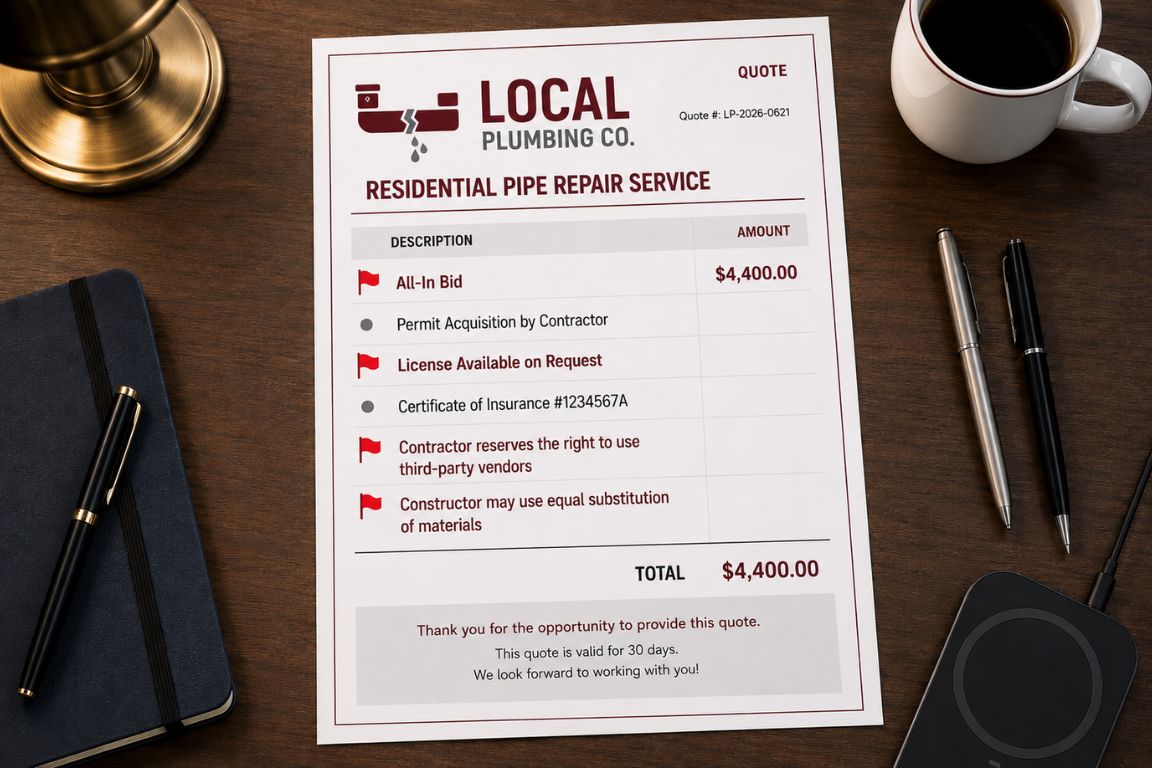


table of contents
table of contents
You got a written estimate for home plumbing repair. But something in your gut’s telling you not to sign. Chances are, you noticed one of the 6 most common red flags in a plumbing quote:
- No fixed price bid in writing
- Missing license and insurance information
- Vague clauses with language you don’t understand
- The “equal substitution of materials” trap
- Fails to accurately describe the scope of repairs
- A bad warranty
Any of these six items should set off alarm bells in your head. They open the door for contractor nightmares like changing prices, low-quality materials and even unlicensed work.
Our Master Plumbers show you how to review your plumbing repair estimate like a pro. Then, we’ll tell you the non-negotiable demands your contractor must meet to deliver a quality quote.
Looking for a second opinion on your DFW plumbing repair? Give us a call 24/7- we’ll review your existing quote and provide an honest assessment of your needs.
1. Every Plumbing Quote Must Have a Fixed Price Guarantee
The question to ask: “Is the price on your bid final?”
“The number you read should be the number you pay,” explains our Responsible Master Plumber Steven Smith (RMP-43457).
An estimate for plumbing repairs is just that- an estimate. Without an explicit guarantee of one fixed price on your agreement, plumbers can change that number on their final invoice without your approval.
You want to see the words “Firm Bid” or “Quote”- not “Estimate” or “Subject to Change”.
Any new discoveries that require additional work should be presented as a fully new quote that requires your approval to proceed.
A Pre-Work Inspection Eliminates “Hidden Fees”
Expect a full diagnostic inspection from a licensed plumber before they submit a bid. This greatly reduces the chances of a “surprise” problem popping up halfway through the repair.
Steven suggests the following inspection equipment and procedures for specific types of plumbing projects:
- Camera inspection for pipe repairs, blockages and sewer cleaning
- Hydrostatic testing for sewer line leaks and pressure issues
- Acoustic leak detection for underground burst pipes and pinhole leaks
- Infrared thermal imaging for hidden leaks behind drywall or under flooring
“A good plumber shows you the footage and images after the inspection,” Steven adds. “You see what we see, you know what we know. You’ll never walk into a proposal blind.”
Be Skeptical About a Quote Over the Phone
A plumber who quotes your repair project over the phone has no idea what they’re pricing. They haven’t seen the problem or assessed the actual damage on site.
Some contractors advertise a ridiculously good offer to get their foot in the door. Then, a bunch of new charges for “work they found along the way” end up on your bill.
2. Look for Clear License and Insurance Information
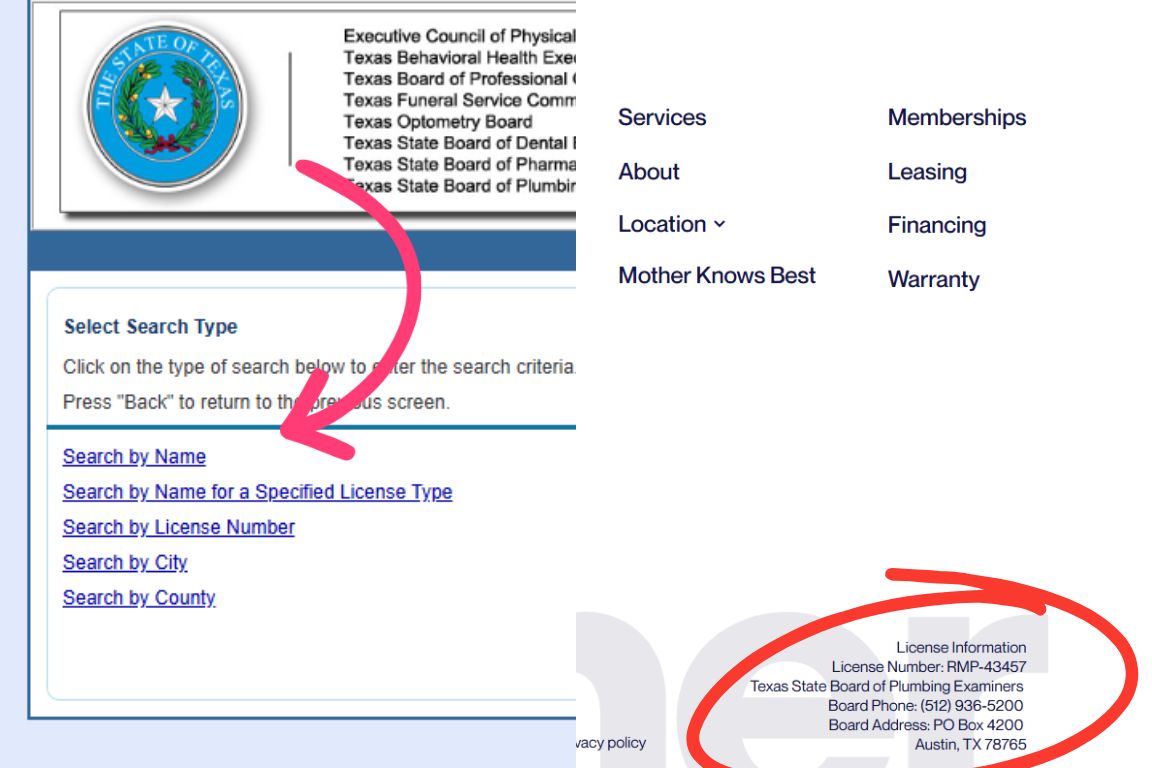
Your plumbing bid must include the active license and insurance information of the contractor or company providing the quote. Here’s what you need to see:
- Active license (in Texas, this begins with “RMP”).
- Active Certificate of Insurance (COI)
Texas State law requires a plumbing company to have a Responsible Master Plumber (RMP) with at least $300,000 of active Commercial General Liability (CGL) insurance.
If your plumber doesn’t comply with these regulations, you’re on the hook. The Texas State Board of Plumbing Examiners (TSBPE) fines you up to $5,000 per day for unlicensed contractor work- on top of the fines your city will impose.
How to Cross-Check Your Texas Plumber’s Active License
Use the TSBPE’s public search portal to check that your plumber’s Texas license is active- and that they provided a real license number.
3. Three Clauses to Avoid in a Plumbing Contract
“Most people don’t read clauses, terms and conditions,” Steven admits. “They’re usually annoying and full of jargon. But you need to take the time and do it- this is where shady contractors hide stuff they don’t want you to notice.”
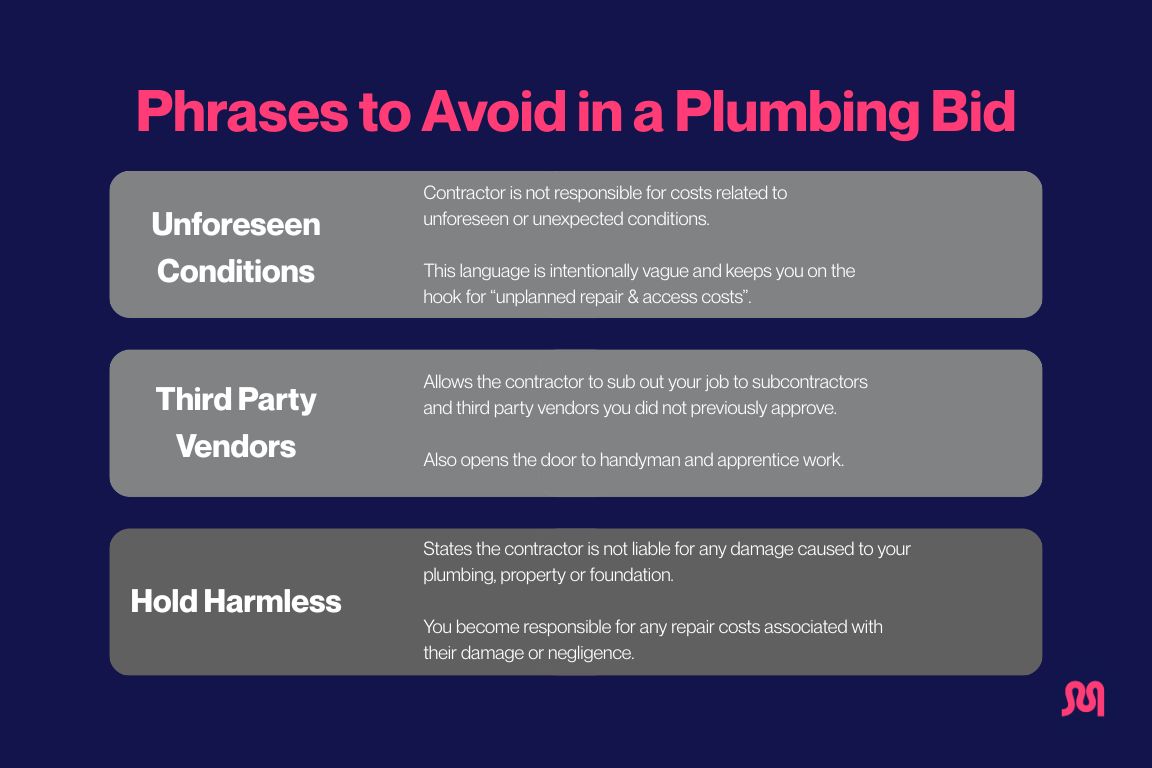
Here are three “deal killer” clauses that should stop any plumbing agreement in its tracks, and what they mean in plain English.
Unforeseen Conditions
This phrase means that you’re responsible for any extra costs related to “unforeseen or unexpected conditions” that arise during the repair process- without defining what those conditions are.
“An unforeseen conditions clause basically hands a blank check for the contractor,” Steven states. “Don’t agree to it.”
These conditions are particularly vague in our DFW Metroplex service area. As plumbers, we constantly encounter issues with shifting clay soil, aging cast iron lines and threatening tree roots.
It’s easy for a shady plumber to suddenly add thousands of dollars to your bill by claiming these common issues weren’t expected- especially if no pre-work inspection was done.
Subcontractors, Third Parties and Apprentices
"Contractor reserves the right to utilize subcontractors or third-party vendors". This clause allows your licensed plumber to hand off your work to contractors you haven’t met, and even other companies entirely.
This practice is a little too common in DFW, where lead generation companies pose as licensed plumbers before farming out your work to the highest bidder.
Make sure your contractor discloses any apprentices working on your job site- and the work they will and won’t be doing.
“It’s great to teach the next generation the right way to do things,” Steven says. “But they shouldn’t be doing all the work without proper oversight.”
Hold Harmless
Never agree to a blanket “hold harmless” statement. This is a zero-accountability clause that’s a “restoration of property exclusion” on steroids.
Red-flag language looks something like this: “Contractor is not liable for damage to existing plumbing, flooring, or foundation."
This allows a shoddy plumber to take your job, pass it off to untrained workers or third parties, crack your sewer pipes or water lines, and walk away with a free pass.
4. Specific Plumbing Materials Must Be Listed
A clause that allows plumbers to substitute one material for another is cause for concern.
“Equal substitution doesn’t always mean like-for-like,” Steven states. “It’s a fancy way of saying your plumber can use low quality materials in your house without telling you.”
The phrase “equal substitution of materials” has no place on a quality plumbing quote. It may also be written as “materials of equal or similar quality”.
The “gotcha” looks like this: You’re quoted $3,800 for a gas water heater tank replacement. You agree, expecting a quality product from Rheem or A.O. Smith to cost around $850-$900. Then, the plumber buys a cut-rate $450 tank online and pockets the difference.
Specific Plumbing Materials and Methods Are Doubly Important Underground
Underground plumbing installation and repair bids must include itemized material and parts guarantees.
“By the time you look at the job site, it’s all backfilled and covered up,” Steven notes. “Ask to see the purchased materials before they go in the ground.”
Real-world example: There’s a huge difference between Schedule 40 PVC and cellular core PVC. Schedule 40 has thicker walls and is engineered to withstand shifting soil, intrusive roots and other buried pipe issues. Cellular core PVC is thinner, more flexible and easier to break.
Learn how to spot the difference, plus other specific sewer repair quote items to watch out for in our updated guide.
{{dfw-sewer-repair-quotes-8-things-to-check-before-you-sign="/blogs/dfw-sewer-repair-quotes-8-things-to-check-before-you-sign"}}
5. Look for Specific Language, Avoid Vague Descriptions
It’s tough to read a plumbing quote when it’s full of technical language and specific names of plumbing materials.
“You get a water heater replacement bid for $3,500- great,” Steven says. “But how much of that is installation? Are they upcharging their labor and putting in a low-quality unit? You don’t know.”
Compare the language in your bid to other competing offers. Look for sections that accurately describe the actual scope of your job:
- Labor cost, including diagnostics, access and the actual service
- Rate breakdown based on specific service (i.e. cost per linear foot for pipe repair or rerouting, or hourly cost for water heater repairs)
- Parts and materials, including the specific products and materials purchased and their list prices
- Permits and inspections, with the accurate current cost to pull a permit and schedule city building inspections
- Any upgrade labor required to bring your home up to code
- Any removal and disposal costs of outdated materials, appliances and fixtures
Be wary of quotes that don’t include complete information, or feature vague language.
6. Compare the Warranty Offer to Other Local Plumbers
Look for a contractor’s warranty offer on a plumbing quote. This should include coverage for all parts and labor associated with your specific repair or installation job.
Compare their offer with other similar warranties from competing local plumbers. Are they best in class? Do they come close? Or are they lacking?
Here are some of Mother’s DFW plumbing warranty offers:
- Whole home pipe replacement: 20 years
- Water heater repair and replacement: 12 years
- Sewer line and water line repair: 6 years
- Slab leak repair: 6 years
- Drain cleaning: 120-day no clogs guarantee
Red Flags on a Real Plumbing Quote
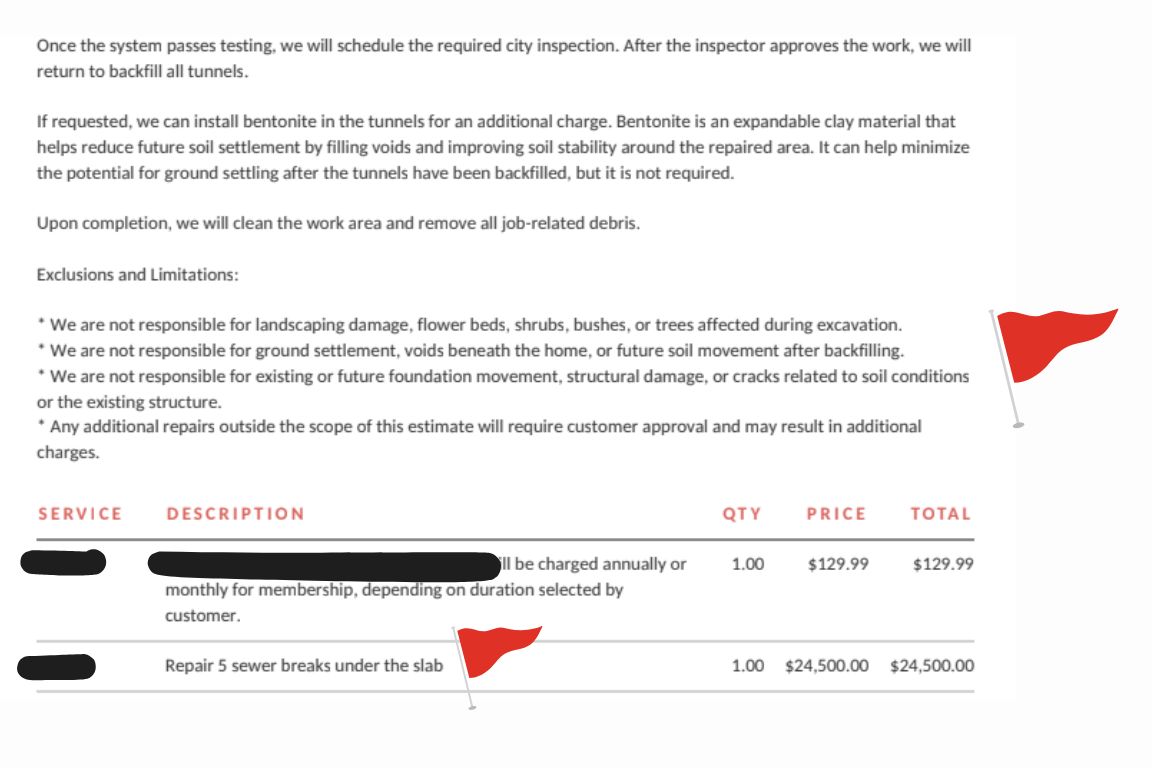
A Rowlett, TX homeowner contacted us for a second opinion on her repair quote. She provided the competing bid, and we noted several red flags:
- Multiple clause issues. Too many exclusions and opportunities to pass the buck on property damage.
- Vague pricing. No specific language regarding the repair method or material selection.
- No warranty listed. There is no workmanship warranty listed in the quote.
The Golden Rule: Always Get a Second Opinion

Get multiple bids from licensed plumbers before you make a decision, if you have the time to do so. You’ll empower yourself to compare and review terms and pricing- and come up with the best questions to ask each plumber about their competing bids.
“Get a second opinion, even if your first quote is from us,” Steven concludes. “The best option for you becomes clearer that way.”
Get a second opinion on your DFW plumbing quote. Call Mother 24/7 for priority scheduling with our Master Plumbers!