Same-Day Plumbing Leak Detection in North Richland Hills

What's Included:
- Fixed Quote Emergency Leak Detection Service
- Underground Leak Detection With No Digging
- Licensed Plumbing Leak Detection Specialists
- "Best in DFW" Leak Locator Technology
- Get Same Day Service!
- Family Owned and Operated
- Fix Your Issue 100% Guaranteed



Water Leak Detection in North Richland Hills: Diverse Solutions for Diverse Home Builds

You were moving boxes in the garage and spotted a damp crack in the slab foundation that seems to stay wet regardless of the weather. It has not rained in North Richland Hills for two weeks, yet the dark clay soil around the crack is soft and waterlogged. This is a signal that a pressurized line is failing against the limestone bedrock beneath your floor.
Mother Modern Plumbing uses acoustic and thermal sensors to locate these breaches before they compromise your structural stability.
Call Mother 24/7 for water leak detection in North Richland Hills.
Mother’s Modern Approach to Plumbing Leak Detection
A plumbing leak is stressful enough. Our job is to find the problem without adding more chaos to your home.
The Leak Detection Equipment We Use
- Acoustic listening devices: High-sensitivity microphones that hear the specific sound of water escaping through concrete.
- Infrared thermal imaging: Cameras that see temperature patterns hidden behind your walls and floors.
- Electronic leak detection: Sensors that map your plumbing and identify exactly where pressure is dropping.
- Hydrostatic testing: A pressure test that confirms if your supply or drainage network is losing volume.
- Plumbing cameras: Waterproof cameras that provide visual proof of pipe cracks or root intrusion.
Mother’s Precision Leak Detection Service in North Richland Hills
We perform a full system audit to verify the leak and quantify exactly how much water is escaping. Our technicians isolate your hot and cold lines to determine which part of the house is losing pressure. Once pinpointed, we mark the location with surgical precision so we can plan a permanent fix.
Discover our full leak detection service process at https://www.callmother.com/services/leak-detection.
Case Study: Resolving a Hidden Slab Leak in North Richland Hills
We recently assisted a North Richland Hills homeowner with a major underground water loss. Our team performed a forensic sweep and located a failure on the cold water line deep beneath the foundation.
To reach the breach, we excavated and tunneled 38 feet under the front exterior wall. This allowed us to access the damaged copper piping without cutting through the interior flooring. We removed the compromised section and installed a new segment using code-approved couplings.
We also rerouted a cold-side water line through the subfloor to install a new exterior hose bib with a vacuum breaker.
After we backfilled the tunnel and cleaned the work area, we performed a final pressure test to ensure the entire system was holding perfectly.
{{slab-leak-repair="/services/slab-leak-repair"}}
In-Home Water Leak Detection
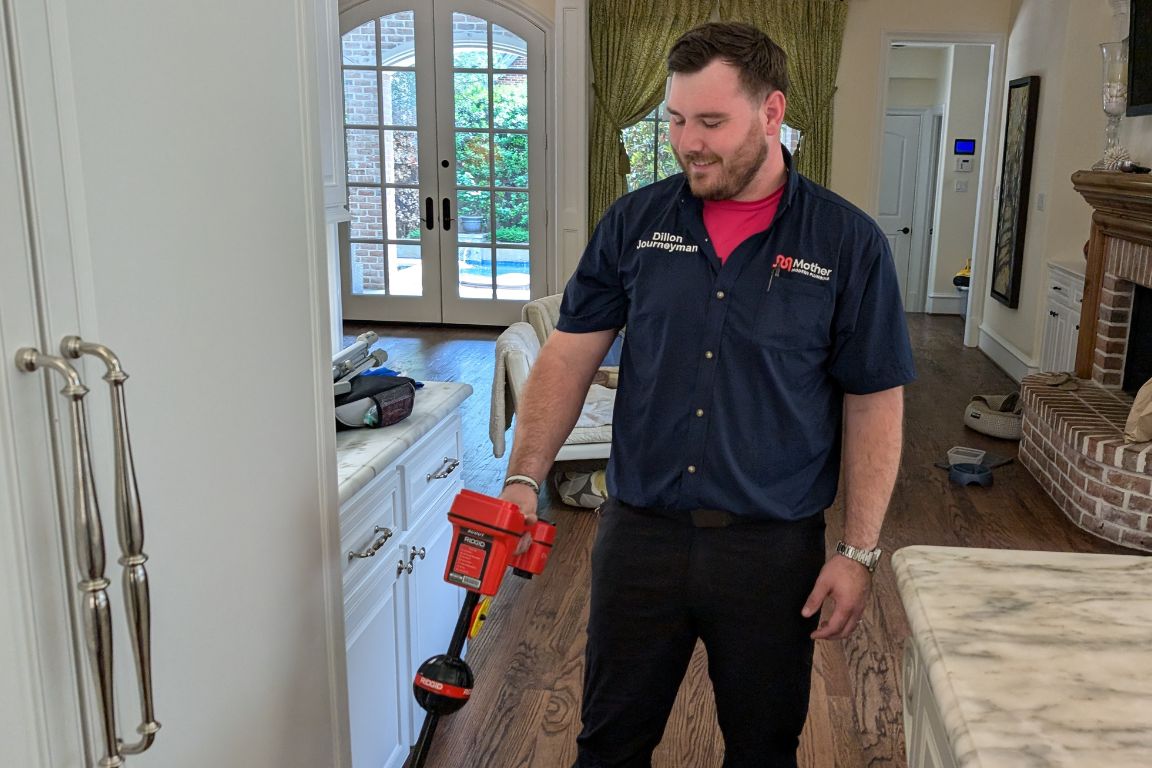
Interior leaks occur in the pressurized pipes hidden in your walls or ceilings. In North Richland Hills, these are often the result of aggressive mineral scale. Our water comes from surface reservoirs like Eagle Mountain Lake, which means it carries a heavy mineral load. Over time, these minerals form scale that causes electrolysis in copper pipes. This process eats away at the metal until a tiny pinhole leak forms inside your walls.
Aging Copper Infrastructure in Bridlewood
Bridlewood is an intimate community built between 1993 and 1997 near Green Valley Park. The homes here feature original copper plumbing that has been exposed to decades of hard water stress. We frequently find in-wall pinhole leaks in the master baths of these mid-1990s residences where mineral deposits have weakened the subfloor joints.
{{leak-detection="/services/leak-detection"}}
Yard Leak Location
Yard leaks happen in the service line between your city meter and your foundation. These are common in North Richland Hills because of our dark clay soil and limestone bedrock. This ground shifts constantly, which pulls at buried joints. Because the soil is thin over the limestone, moisture from a leak often stays underground until the ground becomes completely waterlogged.
Live Oak Root Intrusion in Woodland Estates
Woodland Estates is known for its large homes and spacious lots with abundant vegetation. The live oak trees in this central neighborhood have deep root systems that often seek out moisture in buried pipe joints. When the clay soil shifts, it creates small cracks that allow roots to enter and expand. This is a primary cause of yard leaks and sewer blockages in this established neighborhood.
{{yard-leak-locating="/services/yard-leak-locating"}}
Serving Water Leak Detection Across Every North Richland Hills Neighborhood



Zander Sladek
Bryan and Josiah did a fantastic job, my garden had started flooding so I called and they came out, found the leak, and fixed it very quickly. They were very polite and helpful, and I would happily recommend or call on them again.
March 2026

Catherine Rodriguez
They were very responsive—and finished job earlier than estimated. Highly recommend!
June 2023

Paula King
Very impressed with this company. Chris and Steve were so professional, honest and kind. Arrived on time, communicated clearly. Wasn't able to complete all needed repairs at this time, but will definitely call them when we can. They did some repairs to help now. Highly recommend.
September 2023
What leak detection equipment do you use in North Richland Hills?
Why is my North Richland Hills water bill so high for no reason?
What are the signs of a hot water leak in North Richland Hills?
What is acoustic leak detection?


-(27).webp)
-(22).webp)
-(16).webp)
-(8).webp)