Pipe Bursting vs Pipe Lining: Compare Trenchless Solutions
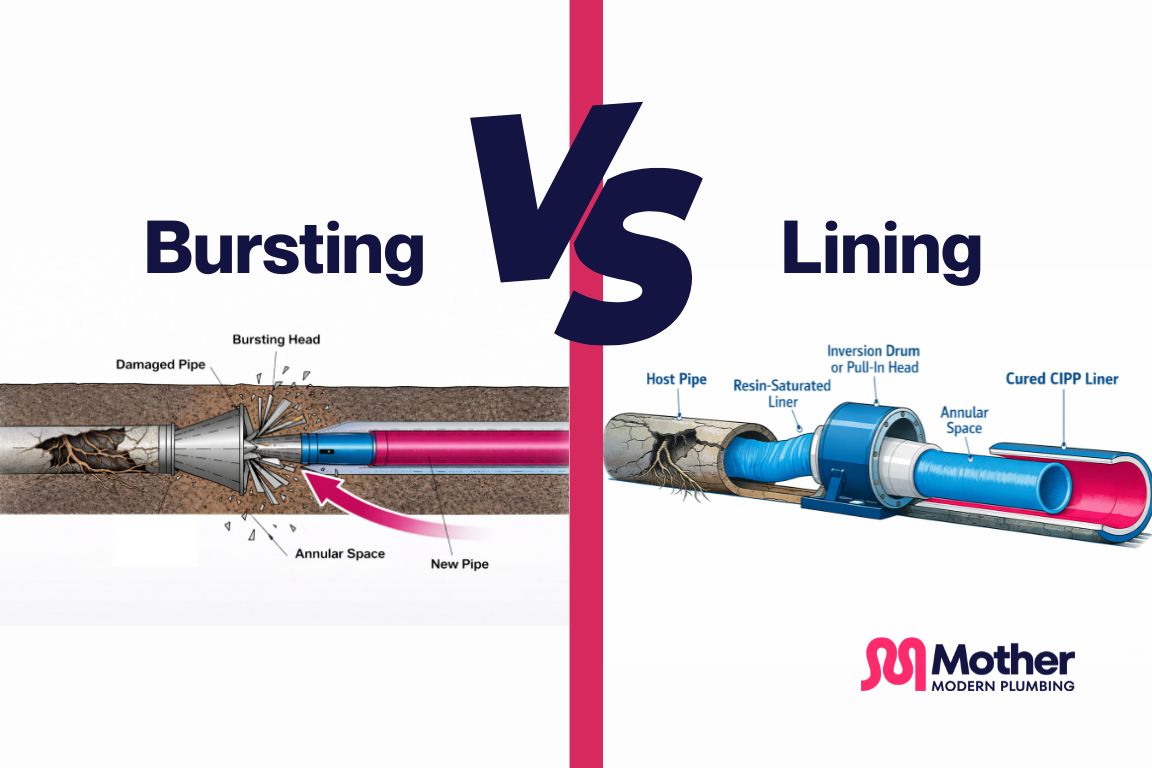

table of contents
table of contents
Pipe bursting and CIPP pipe lining are both trenchless options, but they work completely differently. Pipe bursting removes your old pipe and replaces it with new material. CIPP lining creates a cured in place pipe inside your damaged existing line. The right choice depends on what's damaged, what it's made of, and where the damage is located.
CIPP lining is ideal for sewer line repairs, with its non-invasive access via exterior sewer cleanout and cheaper price point. Pipe bursting is superior for trenchless water line repairs, with its ability to completely remove longer sections of damaged pipe.
At Mother, we've completed hundreds of trenchless pipe repair projects across Dallas-Fort Worth. This guide explains when each repair solution excels, when it fails, and how to choose based on your specific damage and pipe material.
Weighing trenchless pipe repair options in DFW? Call Mother 24/7 for camera inspection and honest guidance on whether pipe bursting or CIPP lining fits your situation.
{{trenchless-pipe-repair-dfw="/services/trenchless-pipe-repair-dfw"}}
Comparing Pipe Bursting vs CIPP Lining Side by Side
Don't have time for a deep dive? Here's a summary of everything you need to know about trenchless pipe bursting versus CIPP relining- we'll get into greater detail throughout the article.
Bursting vs Lining: Trenchless, But Not the Same
The key distinction between pipe bursting and CIPP lining isn't cost or timeline- it's what happens to your old pipe.
Trenchless Pipe Bursting Completely Replaces Your Pipe
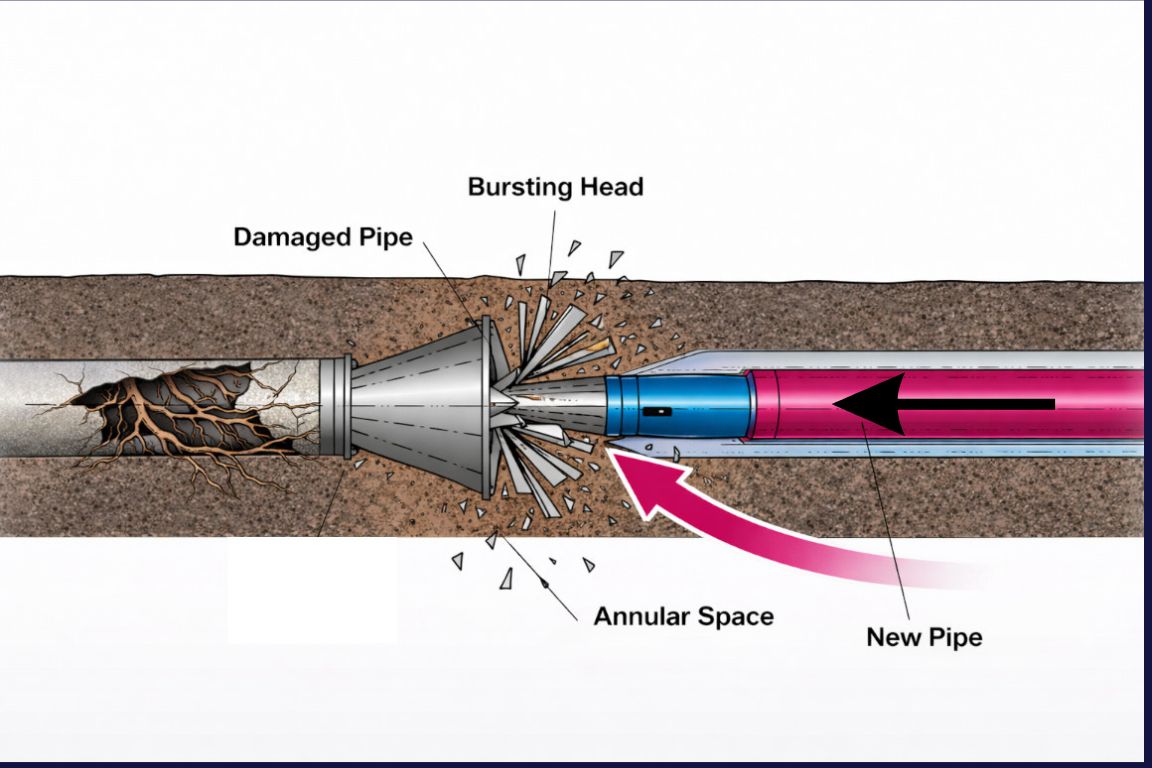
Trenchless pipe bursting destroys your existing pipe and removes it from the ground. A cone-shaped bursting head gets pulled through your damaged line, breaking it apart into fragments that push into the surrounding soil.
The head pulls new pipe behind it- typically HDPE pipe material. Your old corroded metal or cracked plastic pipe is gone. What remains is a brand new buried pipe in the same location.
{{why-dfw-residents-are-choosing-trenchless-pipe-bursting="/blogs/why-dfw-residents-are-choosing-trenchless-pipe-bursting"}}
CIPP Pipe Lining: A New Pipe Within Your Damaged Section
CIPP lining (cured in place pipe) leaves your old pipe exactly where it is and creates a new pipe inside it. A flexible fabric tube gets inserted into your damaged line, inflated to press against the interior walls, then cured in place until it hardens.
The old pipe becomes an outer shell protecting the new epoxy liner. Your cracks and leaks are sealed, but the deteriorated material remains underground.
This fundamental difference determines which solution works for which situations.
{{cipp-lining-everything-you-need-to-know="/blogs/cipp-lining-everything-you-need-to-know"}}
When In Doubt: Relining for Sewers, Bursting for Water Lines
Our Master Plumber Willy Dayton (M-46449) is a trenchless pipe repair specialist. He’s performed residential trenchless service for hundreds of homeowners in Texas and California. For him, the choice between pipe bursting and relining comes down to what pipe you’re fixing.
Choose CIPP Sewer Lining to Repair Your Drainage Line
Relining your damaged sewer pipe section with cured-in-place piping is the right option for homeowners- especially if you have an exterior sewer cleanout. It’s less invasive and less expensive than pipe bursting for trenchless sewer main repair.
“Sewer pipe bursting almost never makes sense for residential jobs,” Willy states. “It’s used a lot in commercial sewer upgrades where they have to go from a 4-inch to a 6-inch sewer pipe.”
“But unless you’re fixing a really long pipe run- like your whole main sewer line, it’s not worth it for homeowners. CIPP lining's better for sewer spot repairs."
Pick Pipe Bursting for Trenchless Water Line Repairs
By contrast, Willy strongly prefers trenchless pipe bursting for replacing water line damage under your yard or a leak near your foundation.
“Bursting a damaged water line outperforms CIPP lining in most residential cases,” Willy says. “Relining a water pipe reduces its interior diameter, which isn’t great for a pressurized line. You don’t get that diameter reduction with bursting.”
Willy also prefers pipe bursting’s ability to get the old water line out of the ground and fully replace it with a new section of HDPE.
“I’m on multiple trenchless pipe repair jobs every week in DFW,” Willy concludes. “9 times out of 10, we’re bursting a water line and relining a sewer pipe.”
When Pipe Bursting Excels
Complete Pipe Removal Solves Specific Problems
Pipe bursting gets your old, degraded pipe out of the ground. This matters enormously when your pipe material itself is the problem- not just damage to an otherwise sound pipe.
Collapsed underground lines can't accept CIPP lining because there's no interior space to insert and inflate the liner. Pipe bursting breaks through the collapsed section and replaces it entirely.
Severely corroded cast iron crumbles during the cleaning required before CIPP installation. Bursting removes the corroded material completely and replaces it with corrosion-resistant PVC.
Outdated pipe materials like Orangeburg (tar paper pipe) or clay with separated joints get eliminated through bursting. You're not reinforcing failing material- you're replacing it with modern pipe rated for 100+ years.
Pipe Diameter Stays the Same or Increases
Pipe bursting maintains your original pipe diameter or allows you to upsize. If your 4-inch sewer line is undersized for your home's current usage, you can burst it and pull through 6-inch pipe in the same trench. (This is far more useful for commercial jobs than for homes.)
CIPP lining always reduces interior diameter slightly as the liner takes up space inside your existing pipe. For most residential applications, losing 1/4" doesn't affect performance. But if you already have flow issues from an undersized line, lining makes the problem worse.
Best Use Cases for Trenchless Pipe Bursting
- Completely collapsed pipe sections - No interior space exists for liner insertion
- Severely deteriorated metal or clay - Material too fragile to support liner installation
- Outdated pipe materials requiring removal - Heavily corroded copper, cast iron or fully outdated Orangeburg sewer pipes
- Undersized sewer lines needing larger diameter - Upsizing from 4-inch to 6-inch lines
- Deep underground pipes - Where access pits are feasible but liner insertion would be difficult
- Situations where complete material removal provides value - Contaminated soil around corroded pipes or root-damaged sections
When Pipe Bursting Isn't the Right Choice
- PVC and HDPE pipes with minor, localized cracks - The pipe material is sound and will last decades. Bursting wastes money replacing pipe that only needs spot sealing
- Pipes in extremely tight spaces with no room for access pits - When your line runs through areas where even small excavation pits would require demolishing expensive structures or cutting through foundations
- Very shallow pipes close to surface utilities - When the bursting head could damage nearby electric, gas, or fiber lines that can't be safely relocated during the process
When CIPP Lining Excels

Keeping Existing Pipe Minimizes Disruption
CIPP lining works through existing cleanouts or small access points. If your home has good cleanout access and your pipe is structurally sound except for cracks or root intrusion, lining requires almost no excavation.
Pipe bursting needs two access pits- one for the bursting head entry and one for the winch pulling it through. If your damaged section runs under a pool deck, mature landscaping, or expensive hardscaping where even small pits would be costly, CIPP lining's cleanout-only access becomes appealing.
Structural Reinforcement Without Full Replacement
CIPP lining adds strength to pipes that are cracked but not collapsed. The epoxy liner bonds to your existing pipe walls, creating a composite structure stronger than the damaged pipe alone.
For Schedule 40 PVC sewer lines with small cracks from root intrusion or ground settling, lining seals the damage and prevents future problems without the expense of full replacement. The PVC host pipe provides excellent structural support and bonding surface for the epoxy liner.
Best Use Cases for CIPP Lining
- PVC sewer pipes with localized cracks - Structurally sound pipe with minor damage from roots or settling
- Deep pipes under immovable structures - Where access pits for bursting would require demolishing pool decks, foundations, or major hardscaping
- Pipes with good cleanout access - Existing 4-inch cleanouts eliminate excavation entirely
- Root intrusion with otherwise sound pipe - Seals entry points after hydro jetting removes roots
- Concrete or clay pipes with hairline cracks - Material sound enough to support liner but damaged enough to leak
- Situations where host pipe removal isn't necessary - Pipe material isn't contaminated or creating ongoing problems
- Budget-conscious repairs on sound foundations - Lower cost when pipe structure supports lining
When CIPP Lining Isn't the Right Choice
- Completely collapsed or severely misaligned pipe sections - No interior space exists to insert and inflate the liner; the pipe structure can't support the installation process
- Cast iron pipes with heavy channel rot or severe pitting - The deteriorated surface won't bond properly with epoxy, and the aggressive cleaning required before lining often damages the pipe further
- Bellied or back-pitched pipes with slope problems - Lining preserves the improper slope; it seals cracks but doesn't fix the drainage issue causing standing water and recurring backups
{{cipp-sewer-lining-when-it-works-when-it-doesnt="/blogs/cipp-sewer-lining-when-it-works-when-it-doesnt"}}
How Each Solution Handles Different Pipe Materials
What your damaged water line or sewer pipe is made from is a massive decision point when choosing between these trenchless repair options.
Let’s look at how each one performs in five different pipe material applications.
Underground Water Pipes: Bursting Yes, Lining No
Pipe bursting: Best for complete material replacement or upgrades, which is generally the case when fixing a buried water main. This is especially true near the foundation.
CIPP lining: Less ideal in most cases, especially water line repairs over 10 feet in length. Shrinks the interior pipe diameter, slightly affecting incoming water flow. The existing damaged pipe still remains, leaving some relined sections exposed to soil.
Cast Iron Sewer Pipes: Bursting Yes, Lining No
Pipe bursting: Ideal for replacing cast iron. Removes corroded, pitted pipe completely and replaces with Schedule 40 PVC that won't corrode. Cast iron's brittleness actually helps- it breaks apart easily for the bursting head.
CIPP lining: Poor choice for severely deteriorated cast iron. Heavy channel rot and pitting prevent proper liner bonding. The aggressive cleaning required before lining often damages cast iron further. Only works on cast iron with minor surface corrosion.
{{cast-iron-sewer-line-replacement-in-dallas-your-guide="/blogs/cast-iron-sewer-line-replacement-in-dallas-your-guide"}}
Schedule 40 PVC and PVC Sewer Pipes: CIPP Is The Right Choice
Pipe bursting: Works but often unnecessary. PVC doesn't corrode, so if damage is localized to a few cracks, bursting the entire line wastes money. Better for situations where PVC is undersized or has multiple failures along the entire run.
CIPP lining: Excellent choice for PVC. The smooth, sound pipe walls provide ideal bonding surface. PVC's structural integrity supports liner installation without risk of collapse during cleaning.
Clay Sewer Pipes: Works For Both In Unique Situations
Pipe bursting: Best solution for clay pipes with separated joints or multiple cracks. Removes outdated material entirely and eliminates weak joints where future separations would occur.
CIPP lining: Works for clay pipes in good condition with minor cracks. Fails when joints have separated significantly or pipe sections have shifted. Clay's rough interior can create uneven liner surfaces.
Orangeburg Sewer Pipes: Pipe Bursting Is The Right Choice
Pipe bursting: Only viable solution. Orangeburg (tar paper pipe) deteriorates into mush and cannot support any reinforcement method. Complete removal and replacement with PVC is necessary.
CIPP lining: Never appropriate for Orangeburg. The material is too deteriorated to withstand cleaning, provide bonding surface, or support liner weight.
Project Timelines and Costs Compared
Trenchless Pipe Bursting Timeline
Day 1: Excavate two access pits, set up bursting equipment, pull new pipe through while breaking old pipe, weld new pipe connections. Most residential sewer line projects complete in one full day.
Day 2: Backfill access pits, restore surface, test system. Some projects extend to a second day if pipe runs are exceptionally long or access is complicated.
Total: 1-2 days for most residential applications
CIPP Lining Timeline
Day 1: Clean and prep pipe interior, perform camera inspection, insert and inflate liner, begin curing process.
Day 2: Complete curing (hot water method takes 4-8 hours, UV curing takes 2-4 hours), remove inflation bladder, cut open branch connections, perform final camera inspection.
Day 3: If needed for complex installations or when curing requires extended time in cold weather.
Total: 1-2 days for most homeowners, 3 days for complex or cold-weather conditions
Cost Comparison
Pipe bursting: $150-225 per linear foot for residential sewer lines. Full sewer line replacement typically runs $8,000-$15,000. Access pit excavation and restoration included.
CIPP lining: $125-200 per linear foot for sewer applications. Full sewer line lining typically runs $6,500-$12,000. Lower cost reflects no pipe material disposal, no new pipe material purchase, minimal excavation.
The 15-20% cost difference narrows when comparing long-term value. Pipe bursting provides brand new pipe rated for 100 years. CIPP lining's lifespan depends heavily on host pipe condition and local soil stresses.
The Verdict: Pipe Bursting for Water Lines, Pipe Lining for Sewer Lines

“If I had to choose one trenchless method as better, it’s pipe bursting- but not universally,” Willy concludes. “It’s definitely better for water line repair, but CIPP lining has good uses in sewer spot repairs.”
When your pipe has collapsed, severely corroded, or consists of outdated materials requiring removal, pipe bursting is the only solution that actually solves the problem. CIPP lining can't fix what isn't there, and it can't reinforce pipe too deteriorated to support installation.
When your pipe is structurally sound PVC with localized cracks and you have excellent cleanout access, CIPP lining costs less and completes with less excavation. The 15-20% cost savings makes sense if your host pipe can support 50+ year liner performance.
For the majority of underground pipe failures we see across DFW, pipe bursting delivers complete replacement, maintains or increases pipe diameter, and provides a 50+ year lifespan.
Refer to the specific use cases throughout this article to determine which trenchless option fits your unique pipe material, damage type, and site conditions. One thing’s for sure- if you can avoid excavation, going trenchless saves you a ton of mess and headaches.
Not sure whether pipe bursting or CIPP lining is right for your underground water or sewer line damage? Call Mother 24/7 for honest recommendations based on what your pipe actually needs.
{{trenchless-pipe-repair-dfw="/services/trenchless-pipe-repair-dfw"}}